Maximizing Profitability: Calculating the ROI of a Commercial Chocolate Fountain
In the competitive culinary landscape, businesses are constantly seeking innovative ways to enhance customer experiences and drive profitability. A professional chocolate fountain can be a captivating centerpiece, transforming a simple dessert station into an unforgettable attraction. But beyond the immediate 'wow' factor, how do you truly measure its financial contribution? This guide delves into the essential metrics for assessing the commercial chocolate fountain ROI (Return on Investment), helping you understand its potential to boost your bottom line.
Investing in high-quality catering equipment, such as a robust chocolate fountain, is a strategic decision that promises more than just aesthetic appeal. It’s about creating a unique selling proposition, driving customer engagement, and ultimately, increasing your chocolate fountain profitability. From cafes and patisseries to hotels and catering firms, understanding the financial mechanics of this popular dessert offering is crucial for any forward-thinking business owner.
Calculating the ROI of a commercial chocolate fountain involves assessing the initial investment against consistent revenue generation, factoring in operational costs like premium chocolate, power consumption, and labor. Businesses can expect a significant return through increased customer engagement, premium dessert offerings, and enhanced brand perception, often achieving payback within months to a year depending on usage volume and strategic pricing.
Understanding Commercial Chocolate Fountain ROI
ROI is a fundamental metric that measures the efficiency or profitability of an investment. For a commercial chocolate fountain, it quantifies the benefits derived from its purchase relative to its cost. A positive ROI indicates that the investment is worthwhile, generating more revenue than it consumes in expenses.
Evaluating commercial chocolate fountain ROI is vital for any business planning to integrate this dessert station. It moves beyond anecdotal success stories, providing concrete financial justification for your capital expenditure. This analysis forms a critical part of a comprehensive chocolate fountain business plan, ensuring that your investment aligns with your broader financial goals and contributes meaningfully to your overall dessert station profit margin.
Why Invest in a Professional Chocolate Fountain?
- Enhanced Customer Experience: A flowing chocolate fountain is a theatrical and interactive dessert, creating memorable moments for guests.
- Increased Revenue Streams: It allows for premium pricing on dessert offerings, special event packages, and catering services.
- Competitive Advantage: Differentiate your business by offering a unique and luxurious attraction.
- Versatility: Suitable for a wide range of settings, from daily buffet services to exclusive events.
- Marketing Appeal: Highly photogenic and shareable, it serves as organic marketing for your establishment.
Key Factors Influencing Chocolate Fountain Profitability
Several variables contribute to the ultimate profitability of your chocolate fountain. Understanding and managing these factors is essential for maximizing your return.
Initial Investment Costs
The upfront cost of purchasing a commercial chocolate fountain varies based on size, brand, and features. High-quality professional units, like those from MeyChoco, typically range from $1,500 to $5,000. Beyond the machine itself, consider:
- Fountain Purchase Price: Your primary capital outlay. Opting for durable, high-performance machines made with 304 stainless steel ensures longevity and reduces future repair costs.
- Accessories: Dipping platters, serving utensils, heating lamps.
- Initial Chocolate Stock: Bulk purchase of couverture chocolate.
Operational Costs
These are the recurring expenses necessary to run your chocolate fountain:
- Chocolate Cost: Often the largest recurring expense. Using high-quality couverture chocolate, optimized for fountains, is crucial for taste and flow. Prices can range from $4-$8 per kilogram. A 10kg fountain might consume 5-10kg per service.
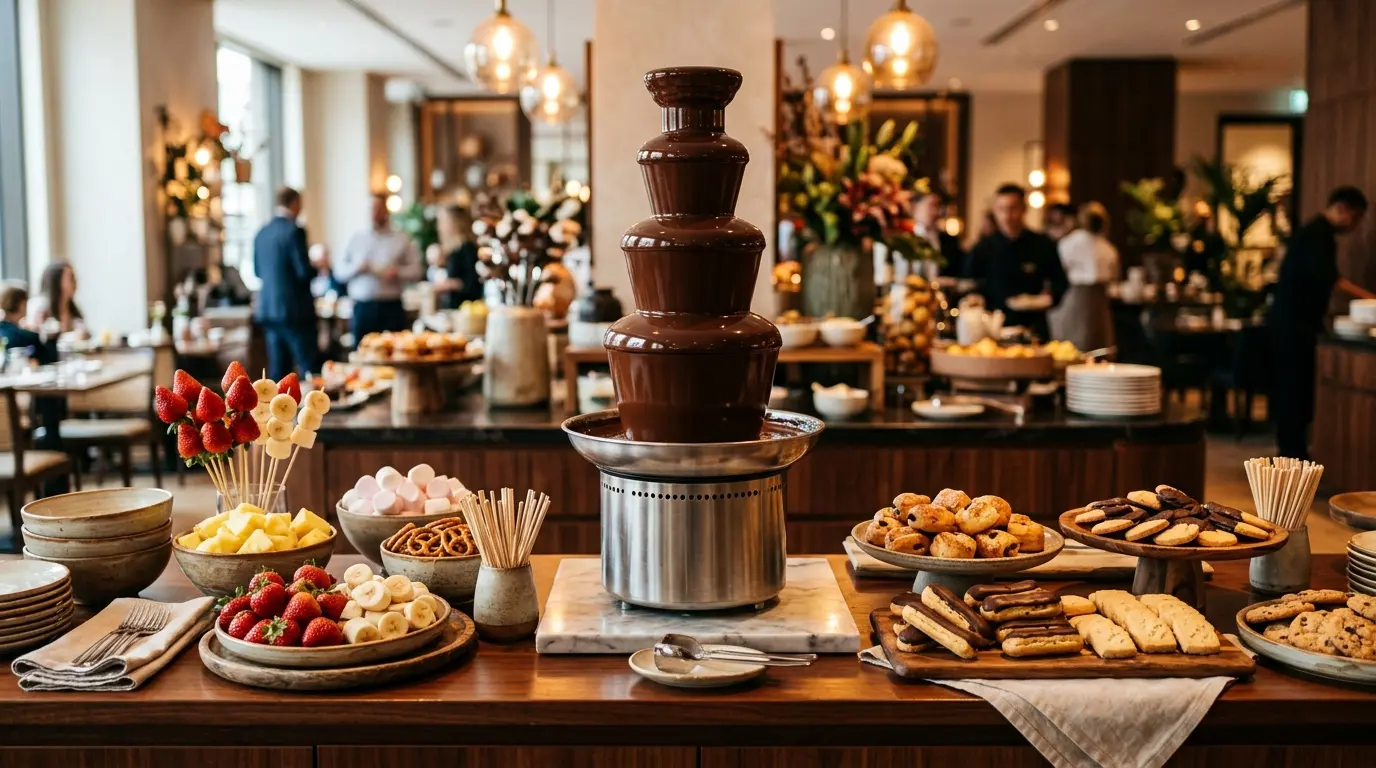
- Dipping Items: Fruits (strawberries, bananas), marshmallows, pretzels, cookies. Costs vary based on seasonality and quantity.
- Power Consumption: Commercial fountains are energy-efficient, but contribute to utility bills. A 10kg fountain might draw 500-800 watts when heating, less when maintaining temperature.
- Labor: Staff time for setup, supervision, replenishment, and thorough cleaning (typically 30-60 minutes per session).
- Maintenance & Cleaning Supplies: Specialized brushes, food-grade lubricants, and occasional spare parts. MeyChoco offers a 10-year auger warranty, reducing long-term maintenance worries for a critical component.
Revenue Generation Strategies
The way you price and market your chocolate fountain offering directly impacts its ability to generate revenue:
- Menu Pricing: Offer as an à la carte dessert, a premium buffet add-on, or part of a fixed-price menu. Prices for chocolate fountain access can range from $5-$15 per person for buffet style.
- Event Packages: Integrate into wedding packages, corporate events, birthday parties, or catering menus as a luxury upgrade. A dedicated chocolate fountain station for an event can command $200-$500+ per hour, excluding chocolate and dippables.
- Upselling Opportunities: Pair with specialty coffees, dessert wines, or other premium items.
The Impact of Quality and Durability
Investing in a well-built, professional machine significantly impacts your long-term ROI. Cheaper alternatives often lead to frequent breakdowns, poor performance, and a shorter lifespan, resulting in repair costs, lost revenue, and customer dissatisfaction.
KMS Food Machines, with its MeyChoco brand, manufactures professional chocolate fountains since 2005 in Istanbul, Turkey. Their commitment to quality is evident in features like 304 stainless steel construction, precise PID temperature control, and an industry-leading 10-year auger warranty. These features ensure reliable operation, minimal maintenance, and a much longer service life, directly contributing to superior catering equipment investment returns.
Calculating Your Commercial Chocolate Fountain ROI: A Step-by-Step Guide
Let's break down how to quantitatively assess the financial viability of your investment.
Step 1: Determine Total Initial Investment (I)
This includes the purchase price of the fountain and any necessary initial accessories or setup costs.
I = Fountain Cost + Accessories Cost + Initial Stock Cost
Example: A premium 10kg professional chocolate fountain like the MeyChoco Pro might cost $3,500. Add $200 for dipping platters and $100 for initial chocolate stock. So, I = $3,500 + $200 + $100 = $3,800.
Step 2: Estimate Monthly Operating Costs (OC)
Sum up your estimated monthly expenses for chocolate, dippables, power, and labor.
OC = (Chocolate per month) + (Dippables per month) + (Power per month) + (Labor per month)
Example:
- Chocolate: 50kg/month * $6/kg = $300
- Dippables: $150/month
- Power: $20/month
- Labor (setup/cleaning): 10 hours/month * $15/hour = $150
- Total OC = $300 + $150 + $20 + $150 = $620/month.
Step 3: Project Monthly Revenue (R)
Estimate how much revenue your chocolate fountain will generate each month by forecasting usage and average spending.
Example:
- Cafe: 100 customers/month opt for fountain access @ $8 each = $800
- Catering: 2 events/month @ $400 each = $800
- Total R = $800 + $800 = $1,600/month.
Step 4: Calculate Net Monthly Profit (NMP)
Subtract your monthly operating costs from your projected monthly revenue.
NMP = R - OC
Example: NMP = $1,600 - $620 = $980/month.
Step 5: Compute Payback Period and ROI
Payback Period: The time it takes for your investment to generate enough profit to cover its initial cost.
Payback Period (Months) = I / NMP
Example: Payback Period = $3,800 / $980 = ~3.88 months. (You'd recoup your investment in just under 4 months).
Annual ROI (%): A common way to express the profitability over a year.
Annual ROI (%) = ( (NMP * 12) / I ) * 100
Example: Annual ROI = ( ($980 * 12) / $3,800 ) * 100 = ( $11,760 / $3,800 ) * 100 = ~309.47%.
An annual ROI of over 300% demonstrates an exceptionally strong financial return for your catering equipment investment, showcasing the potential for significant chocolate fountain profitability.
Real-World Applications and Business Cases
A professional chocolate fountain's versatility makes it a valuable asset across various business models.
Cafes & Patisseries
For cafes and patisseries, a chocolate fountain serves as a luxurious dessert add-on, attracting customers looking for a unique treat. It enhances visual appeal and drives impulse purchases. Offer it as a weekend special or a permanent fixture for an upcharge, boosting your overall dessert station profit margin. A compact yet powerful option like the MeyChoco Mini-Pro (5+2kg capacity) could be ideal for spaces with moderate foot traffic or limited counter space.
Hotels & Resorts
Hotels can leverage chocolate fountains in breakfast buffets, evening dessert spreads, or as a premium offering for banquet events. It elevates the guest experience, making buffets more appealing and justifying higher room rates or event package prices. The presence of such a lavish amenity contributes directly to increased hotel dessert revenue and guest satisfaction.
Catering & Events
Catering companies and event organizers can offer chocolate fountains as a high-demand premium service. It's a showstopper at weddings, corporate galas, and private parties, often commanding a significant upcharge. The ability to provide a memorable and interactive dessert experience sets you apart in the competitive events market.
Choosing the Right Commercial Chocolate Fountain
To ensure maximum ROI and long-term satisfaction, select a fountain that meets your business's specific needs and quality expectations. Consider:
- Capacity: Do you need a large 10kg fountain for high-volume events (e.g., MeyChoco Pro) or a more compact 5+2kg model for smaller settings or specific menu items (e.g., MeyChoco Mini-Pro)?
- Material: Opt for food-grade 304 stainless steel for hygiene, durability, and ease of cleaning, ensuring compliance with health standards and a longer lifespan.
- Temperature Control: PID (Proportional-Integral-Derivative) systems offer precise temperature regulation, preventing chocolate from burning or seizing, and ensuring a perfect flow.
- Durability & Warranty: Look for robust motors and long-term warranties, especially on critical components like the auger (MeyChoco offers 10 years). This reflects confidence in product quality and reduces future operational risks.
- Ease of Cleaning: Detachable, dishwasher-safe components simplify the cleaning process, reducing labor costs and improving operational efficiency.
KMS Food Machines, through its MeyChoco brand, manufactures professional chocolate fountains in Istanbul, Turkey, that embody these very principles. Their 100% local production ensures meticulous quality control, offering businesses durable, efficient, and aesthetically pleasing solutions designed for sustained chocolate fountain profitability.
Conclusion
A commercial chocolate fountain is more than just a novelty; it's a powerful tool for driving revenue, enhancing customer satisfaction, and building a stronger brand presence. By carefully calculating the commercial chocolate fountain ROI and understanding the factors that influence its profitability, businesses can make informed decisions that lead to significant financial returns.
Investing in a high-quality, reliable machine like those from MeyChoco ensures that your chocolate fountain continues to be a source of joy for your customers and a consistent profit generator for your business for years to come. Explore the range of professional chocolate fountains at cikolatacesmesi.com and discover the perfect addition to your dessert offerings.
Frequently Asked Questions
Q1: What is a good ROI for a commercial chocolate fountain?
A good ROI for a commercial chocolate fountain typically involves a payback period of less than 12 months, and an annual ROI exceeding 100%. High-volume businesses can often achieve a payback in 3-6 months and an annual ROI of 200-300% or more, indicating a highly profitable investment.
Q2: How much chocolate does a commercial fountain use per hour/event?
Chocolate consumption varies based on fountain size, flow rate, and customer traffic. A 10kg fountain might use 2-3 kg of chocolate per hour in a busy setting, or 5-10 kg for a 3-4 hour event. Smaller 5kg fountains will use proportionally less, typically 1-2 kg per hour.
Q3: What type of chocolate is best for a professional chocolate fountain?
Only use high-quality couverture chocolate specifically designed for fountains. This chocolate has a higher cocoa butter content (typically 38-40%), which gives it the perfect fluidity without needing added oil, ensuring smooth flow and superior taste. Avoid standard baking chocolate as it can seize or clog the fountain.
Q4: How often do commercial chocolate fountains need to be cleaned?
Commercial chocolate fountains should be thoroughly cleaned after every use to maintain hygiene and prevent chocolate residue from hardening, which can damage the machine. This typically involves disassembling the tiers and auger, washing all components with hot soapy water, and drying them completely before storage.
Q5: Are commercial chocolate fountains expensive to operate?
While the initial investment can be significant, the operational costs are primarily for the chocolate and dipping items. Electricity consumption is relatively low for modern, energy-efficient machines with PID control. Labor for setup and cleaning is also a factor, but the high-profit margin on dessert offerings generally makes it a very cost-effective and profitable addition.
Q6: Can I use different types of chocolate in a fountain (white, milk)?
Yes, professional chocolate fountains can be used with dark, milk, or white couverture chocolate, as long as it's specifically formulated for fountains. You can also use cheese, caramel, or even barbecue sauce, provided the consistency is correct and the fountain is thoroughly cleaned between different uses to prevent flavor mixing.